
Mid-March 2026 saw Cadent – the UK’s largest gas distribution network – announce an unprecedented 38 applications received during the first window of their new cost-sharing assessment.
The assessment, which is an Ofgem‑supported cost‑sharing model, is designed to reduce financial barriers to operation by enabling biomethane plant developers in constrained areas to cluster and share reinforcement costs.
An impressive figure achieved in an especially short space of time for a necessary innovation, Cadent has gone on to detail the areas in which these applications were received, spanning the length of the UK, with 17 in the East of England, 13 in East Midlands, 5 in West Midlands and 3 in the North West.
And, where this is certainly an encouraging number and shows a real appetite for AD here in the UK – particularly as we enter the “Simpler Recycling” mandate and the need for 150 new AD plants cross-country – it may also serve to signal some slightly more complex issues along the way.
While Cadent frames this as pure developer confidence, the reality on the ground suggests a more urgent, dual-pressure system at play:
The “GGSS Sunset” Panic: The surge in applications is almost certainly driven by the ticking clock of the Green Gas Support Scheme (GGSS) and, although the government recently extended the commissioning deadline to March 31, 2030, the window to secure a Stage 1 Tariff Guarantee is still rapidly closing.
Developers are racing to lock in these guaranteed 15-year rates before the scheme transitions to a more uncertain, market-led model; for many, this “first window” was less about a new start and more about a final sprint to ensure project viability.
The Grid Bottleneck & The “Speculative Cluster”: Cadent’s clustering model is a necessary innovation, but it highlights a painful truth – the UK grid is at capacity, and by receiving 38 applications at once, the network faces a new kind of “administrative bottleneck.”
As noted in recent reports by the Environmental Services Association (ESA), several projects in the Midlands have already faced “connection paralysis,” with some quoted dates as late as 2028 or 2030 which is a vast improvement from a few years ago where some new projects were given connection dates 15 years in the future, but is certainly not ideal for the rate of renewable and clean energy expansion necessary over the next few years.
The Feedstock Pipeline is Expanding
As the “Simpler Recycling” mandate comes into the fore and we see the oncoming transition from purely commercial to both commercial and domestic waste enter the feedstock pipeline, we’ll soon be in desperate need of operational biomethane plants up, down and across the country!
A high volume of applications is one thing; getting them through the technical and regulatory “eye of the needle” to become operational by the 2026/2027 deadlines is quite another.
Real World Resilience
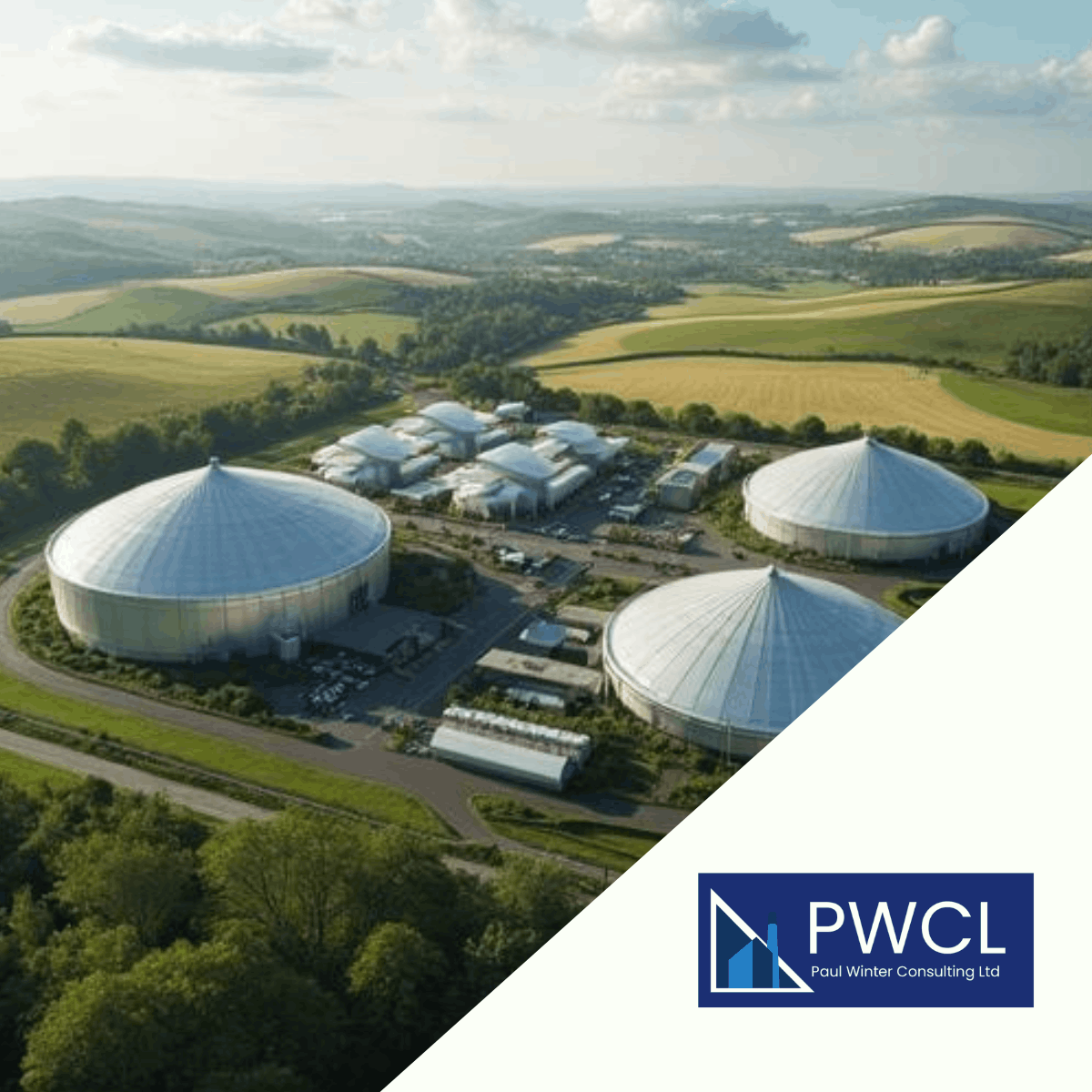
The current surge in speculative applications is a distraction from the real task at hand: the delivery of hard infrastructure and, here at PWCL, we are currently seeing this gridlock play out in real-time across our own portfolio, where we are managing 10 active AD projects across the UK and Europe.
Representing nearly 7% of the total national infrastructure target, these projects provide us with a high-definition view of the current AD landscape; we aren’t looking at this through the lens of a “Stage 1” application window – we are looking at it through the lens of construction, procurement, and the technical resilience required to get gas into the grid today.
However, resilience isn’t just about building fast; it’s about building for the future.
The Next 12 Months
As we move past the March 2026 business mandate and start the 12-month sprint toward the 2027 household deadline, the landscape is shifting and the “April Surge” in applications shows the market is hungry, but the “Grid Bottleneck” proves that only the most technically resilient projects will survive.
True energy security won’t be found in speculation; it will be found in the distributed network of AD plants that are shovel-ready today.
With 10 plants in our active pipeline, including our work on CCUS integration, we are actively committed to ensuring the UK meets its mandate with substance, not just applications.