
As we approach the mid-point of 2026, and the deadline to Net Zero draws another year closer – all eyes have turned toward energy storage technology as the saving grace to effectively and efficiently storing summer sun for winter warmth.
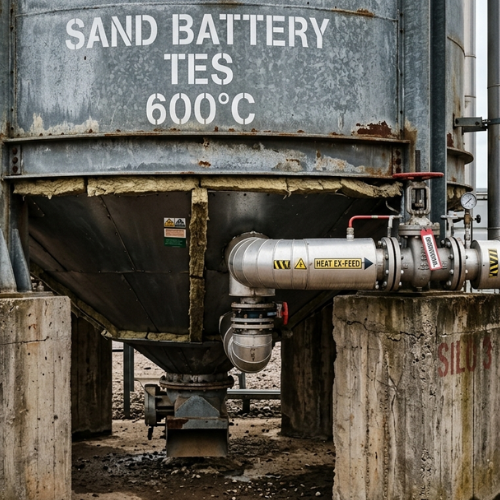
And, whilst lithium-ion batteries are sitting firmly in the spotlight, another related technology is sitting quietly in the background, potentially providing the missing link to comfortably achieving Net Zero: sand batteries, AKA Thermal Energy Storage (TES).
So, in all the energy storage headlines and the lithium-ion battery hype, why is no-one discussing the incredible potential in sand batteries?
TES’ Ambiguous Place in the Energy Market
There are a number of reasons why TES aren’t talked about enough here in the UK, ranging from them being considered a ‘boring’ technology – they’re just not sexy enough! – to their vast space requirements and logistical complexities, not to mention their ambiguous place in the UK energy market.
Large Scale: Sand batteries aren’t batteries in the traditional sense, rather they are vast containers, housing large amounts of sand and therefore require large, insulated silos to function effectively; indeed they are most efficient at scale, when used to heat thousands of homes or provide heat and hot water for complex industrial processes.
Complex Delivery: With this, they are famously complex in delivery; building a system that can retain 500°C–600°C heat for weeks or months on end requires significant engineering in insulation and heat-exchange piping, which adds to the initial construction cost and complexity of a unit.
Limitations: Every technology has some kind of limitation and TES aren’t unique in this respect – they store energy as heat, not electricity – and, although heat can be converted into electricity, the process of doing so loses up to 50% of its output, making it highly inefficient and therefore simply not worth the effort – essentially, they are specific drivers of heat, not electricity.
Economic Drivers: Their value proposition is highly dependent on local energy pricing, the availability of district heating infrastructure, and the specific cost of fossil fuels they are intended to replace. This makes them a regional solution rather than a one-size-fits-all product, which severely limits broad media interest.
That being said, with the 2026 implementation of the LDES cap-and-floor regime and the broader ‘Warm Homes Plan’, the regulatory landscape is finally beginning to recognise the value of non-lithium solutions. This shift provides the necessary revenue certainty to move TES from pilot projects to bankable, long-term infrastructure.
The Misunderstood Clean Heating Technology
TES are widely misunderstood and come with many benefits and multiple uses; both industrial and domestic, and could therefore help significantly decarbonise industrial processes, supporting the UK’s ambitious Net Zero targets.
Decarbonising Industrial Heat: By providing a constant source of steam or hot air for industrial processes, they can replace the fossil fuels currently required to maintain high temperatures in manufacturing, a sector that is notoriously difficult to decarbonise.
Cost Effective & Efficient: What’s more, TES are both cost effective and efficient; sand is a cheap, reliable and easy to source feedstock that is naturally abundant and non-toxic; the “storage medium” itself costs almost nothing compared to the rare minerals required for chemical batteries. And, they are highly effective at retaining heat for long periods – days or even months – which makes them ideal for bridging the gap when renewable energy generation is low.
Long-Duration-Energy-Storage (LDES): Engineering teams currently struggle with the ‘4-hour limit’ of chemical battery arrays. In contrast, sand-based TES provides a stable, multi-day discharge curve. This makes it an ideal solution for ‘dunkelflaute’ events – the periods of low wind and low solar intensity that threaten grid stability. By decoupling energy capture from delivery, we shift the engineering focus from ‘capacity’ to ‘reliability’.
Domestic Heating Role: They serve as an excellent solution for storing excess wind and solar energy generated during peak production times, holding that energy as heat to be distributed later via district heating networks to warm homes.
An Ethical Argument
And, we couldn’t talk about battery storage without touching on the ethical argument against lithium-ion batteries and therefore the ethical & sustainable supply chain that goes along with them.
Although sand batteries are a different technology to lithium-ion batteries, this is true, they share the same goal: helping the UK to achieve Net Zero and, especially pertinent within this context, is the issue of sustainable supply chains.
A substantial portion of the world’s cobalt – which is essential for most lithium-ion batteries – is found in the Democratic Republic of the Congo where there are multiple ethical and environmental concerns spanning child labour, hazardous working conditions, and concerns over the release of toxic chemicals.
Industrial mining for lithium, cobalt, and nickel often involves intensive water use, large-scale land excavation, and the release of toxic chemicals into local soil and water tables.
As such, although typical lithium-ion batteries are viewed as a renewable energy source, they come with a particular ethical and environmental debt that cannot be glossed over or forgotten about.
Sand, on the other hand, provides an ethical alternative:
Inert and Abundant: Unlike cobalt or lithium, sand does not require ecologically destructive mining practices or involve ethically compromised labor chains.
Supply Chain Security: Procurement managers can source sand locally, which aligns with modern goals for ethical, sustainable, and low-carbon supply chains.
Safety and Life Cycle: Because sand batteries are chemically inert, they do not pose the same disposal or “fire risk” challenges as end-of-life lithium-ion batteries, which contain heavy metals that are notoriously difficult to recycle.
Ethical Neutrality: Beyond the moral imperative, there is a clear fiduciary one. With the tightening of the EU and UK’s corporate sustainability due diligence directives, companies are increasingly liable for abuses deep within their Tier 2 and Tier 3 supply chains. Choosing a storage technology that relies on an ‘ethically neutral’ feedstock like sand is not just a ‘green’ choice; it is a strategic move to insulate the firm from future regulatory litigation and reputational damage.
Geo-Agnostic Feedstock: In global procurement, we are seeing a shift away from high-concentration commodity markets (where cobalt and lithium pricing is volatile and geopolitically sensitive). Sand, as a readily available, geo-agnostic feedstock, allows for localized ‘closed-loop’ procurement strategies. This mitigates ‘force majeure’ risks – such as port closures, trade tariffs, or sudden raw material price spikes – that can derail complex multi-year infrastructure projects.
Moving Towards a Diversified Storage Strategy
Ultimately, the transition to Net Zero requires a portfolio approach. While lithium-ion is the established engine for short-term electrical agility, sand-based Thermal Energy Storage (TES) provides the robust, sustainable, and ethically-sound infrastructure necessary for our long-term industrial and domestic heating requirements. By diversifying our storage feedstock, we are doing more than just hitting targets – we are building a more secure and resilient energy future.
For the industry to move beyond the current “lithium-first” mindset, we must view energy storage not as a monolithic hardware category, but as a diverse portfolio of solutions. Just as a balanced investment strategy mitigates financial risk, a balanced energy storage strategy – one that intelligently leverages both electrical and thermal media – is the only way to build truly resilient, decarbonised infrastructure.