

Energy from waste (EfW) and waste incineration are being brought into the UK Emissions Trading Scheme (UK ETS). The transition voluntary MRV period is already underway, ahead of possible full inclusion from 2028.
Operators face a significant challenge to understand the risks, get to grips with the carbon market and develop a procurement strategy for allowances. However, lessons can be learned from 6 years of compliance experience under the UK ETS, writes carbon risk management firm, CFP Energy
EfW in the UK ETS – an overview
The waste sector’s entry into the UK ETS follows a two-stage timeline:
- 1 January 2026 – 31 December 2027: a voluntary Monitoring, Reporting and Verification (MRV-only) period 1. Operators are expected to measure and report emissions in line with UK ETS methodology, but there is no obligation to purchase or surrender allowances during this period, and no penalties for non-participation.
- From 1 January 2028: full UK ETS compliance obligations are expected to apply, subject to a further UK ETS authority response . In-scope operators will be required to surrender one allowance for every tonne of CO2e emitted.
The scope covers advanced thermal treatments, waste-to-fuel production (including Sustainable Aviation Fuel), and non-mechanical recycling processes where combustion or fuel use occurs.
The inclusion threshold aligns with the existing Small Waste Incineration Plant (SWIP) criteria: facilities processing 3 tonnes or more per hour of non-hazardous waste, or 10 tonnes or more per day of hazardous waste, are in scope. Clinical waste incinerators are included during the MRV-only phase, but this position remains subject to reassessment ahead of full inclusion in 2028.
High-temperature incinerators that primarily process hazardous waste are excluded for the time being, in order to preserve domestic hazardous waste treatment capacity and limit the risk of waste being exported for treatment elsewhere.
| Factfile: what is the UK ETS? The UK Emissions Trading Scheme is a cap-and-trade carbon pricing mechanism introduced across the power, industrial and aviation sectors from 1 Jan 2021, replacing the EU ETS post Brexit. Domestic shipping voyages are also included since 1 July 2026. Covered installations or operators must surrender one UK Allowance (UKA) for every tonne of CO2e they emit annually. The total number of allowances available is capped, and that cap declines over time — which in principle drives down emissions as scarcity pushes up costs. Some industry sectors receive a “free allocation” to avoid any carbon leakage impacts. Learn more here. |
Preparing for compliance
The voluntary MRV period is an opportunity for operators in the sector to prepare for compliance gradually.
With no allowance obligation planned until 2028, the voluntary phase gives time to establish monitoring systems, test data quality, and work through practical issues with regulators before compliance costs apply. Facilities that use this period to build robust MRV processes will be better placed to manage compliance costs and reporting obligations should the scheme become mandatory in 2028.
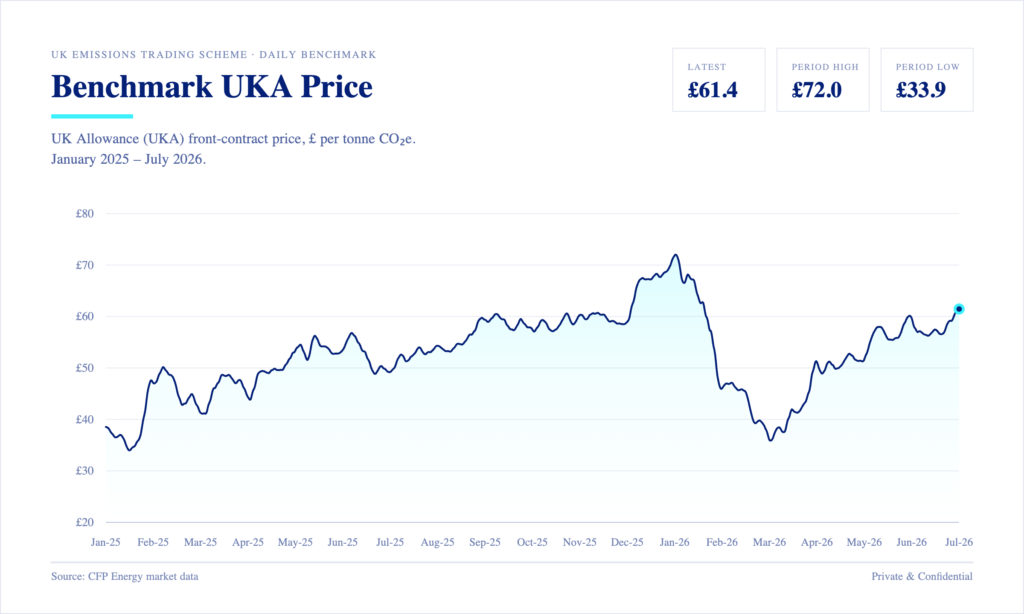
A volatile carbon market
Early alignment also allows time to prepare a robust compliance strategy. A key concern is that UK ETS costs incurred by EfW operators are likely to be passed through to local authorities and commercial waste customers. This could materially increase residual waste disposal costs from 2028 onwards.
Tim Atkinson, Head of Carbon at CFP energy highlights the importance of preparing early for the start of the compliance phase
“Now is the time to understand the carbon market and identify solutions to manage the procurement of UK Allowances. With a decreasing cap and expanding scope, market balances are fundamentally tightening and UKA prices are projected to rise steeply.”
In addition, the UK ETS faces a shift with the expected upcoming linkage with the EU ETS. A political announcement is expected in Autumn 2026, which is already leading to price convergence – pushing the cost of UK Allowances higher.
Early action will be rewarded
CFP Energy specialises in working with ETS operators to help them understand policy, keep up to date with the carbon market, develop a compliance strategy and execute UKA trades effectively. Given the specific challenges of the EfW sector, our experience working with over 100 UK operators can help you plan the right procurement solutions to manage cash flow and pass through costs – see https://www.cfp.energy/en/insights/managing-uk-ets-compliance-smarter-procurement-with-cfp-energy.
We offer a full range of carbon trading and procurement solutions, including spot and forward allowance transactions, order triggers to take advantage of sudden market movements and innovative structured products to manage price risk and achieve discounts on current carbon prices.
Our award-winning team can help you and your business navigate carbon markets with clarity and confidence. Learn more about our market-leading support, here.