
Standfirst: As the UK Emissions Trading System expands to include Energy from Waste, AMP explains how AI-driven advanced sorting offers local authorities an immediate, affordable way to cut emissions, control costs, and strengthen circularity ahead of 2028.
The expansion of the UK Emissions Trading System (ETS) to Energy from Waste (EfW) facilities marks one of the most significant regulatory shifts the waste sector has faced in decades. Starting in 2028, EfW plants will be required to pay for any fossil-derived carbon dioxide released when residual waste is incinerated, following a two-year monitoring, reporting and verification (MRV) period beginning in 2026.
For local authorities, the implications are profound. According to the Chartered Institute of Waste Management (CIWM), ETS exposure could cost councils more than £600 million annually once the scheme is fully implemented. At a time when municipal budgets are already under pressure, ETS introduces a new, volatile and largely unmanaged cost into the system, unless decisive action is taken.
While much of the industry conversation has focused on carbon capture and storage (CCS) as the long-term answer, there is a growing recognition that councils need solutions that can be deployed now, not in five or ten years’ time. Advanced mechanical and AI-driven waste sorting is emerging as one of the most practical and cost-effective ways to prepare for ETS compliance, delivering immediate carbon reductions while supporting longer-term decarbonisation strategies.
ETS and the new cost reality for local authorities
The UK ETS is a cap-and-trade system designed to put a price on carbon emissions and incentivise reductions across the economy. Under the expanded scheme, EfW facilities will need to purchase and surrender allowances for fossil CO₂ emitted from burning residual waste.
Current estimates suggest that around 0.5 tonnes of fossil-based CO₂ are produced for every tonne of residual waste sent to EfW. With ETS allowance prices modelled between £69 and £124 per tonne of CO₂, and a central estimate of around £98 per tonne used in the CIWM analysis, the financial exposure quickly becomes clear.
For a council sending 50,000 tonnes of residual waste to EfW each year, ETS charges alone could reach £2.5 million annually, before factoring in additional MRV sampling and reporting costs, estimated at around £15,000 per 5,000 tonnes. Multiply this across the UK’s 63 operational EfW plants, with more coming online, and the national cost rapidly exceeds half a billion pounds per year.
While ETS introduces a significant new cost pressure, it also creates a clear opportunity for councils to respond in a capital-light way. By adopting advanced sorting approaches that reduce fossil content in residual waste, local authorities can materially lower their ETS exposure without committing to large upfront infrastructure investments. These solutions can be delivered through capital-light or no-capital-down models, allowing councils to mitigate ETS costs, protect tip fees, and increase system flexibility while preserving scarce capital for other priorities.
This approach contrasts with more capital-intensive alternatives such as carbon capture and storage (CCS). Sorting provides a more directly controllable intervention for local authorities, whereas CCS depends on the availability, performance, and long-term viability of external infrastructure and third-party delivery models. This distinction is important when assessing implementation risk, delivery timelines, and long-term operational flexibility in the context of ETS compliance.
The limits of CCS as a near-term solution
Carbon capture and storage is widely recognised as an important part of the long-term strategy to net zero for EfW. However, it is not a silver bullet, particularly for local authorities facing ETS costs within the next five years.
CCS projects are capital-intensive, operationally complex, and heavily dependent on government support and shared infrastructure. Most announced projects are still in development, with only a handful expected to be operational before the end of the decade. Many internationally face bottlenecks associated with availability and cost of long-term storage of the carbon.
While CCS offers a pathway to reduce emission sources at the facility level, it primarily addresses downstream emissions rather than upstream material flows, including the treatment of high-carbon materials such as plastics. Depending on the application, the added energy demand of CCS can introduce additional system considerations, reinforcing the value of integrated, system-level optimisation.
This has led to growing interest in alternative approaches that can be implemented quickly, scaled flexibly, and controlled directly by local authorities.
Reducing emissions before incineration
One of the most effective ways to cut ETS exposure is also one of the simplest in principle: reduce the fossil carbon content of waste before it reaches the incinerator.
Typically, 20–30% of municipal solid waste (MSW) is made up of fossil-based materials such as plastics, synthetic rubbers and certain textiles. These fractions are responsible for a disproportionate share of EfW emissions, and therefore ETS liabilities.
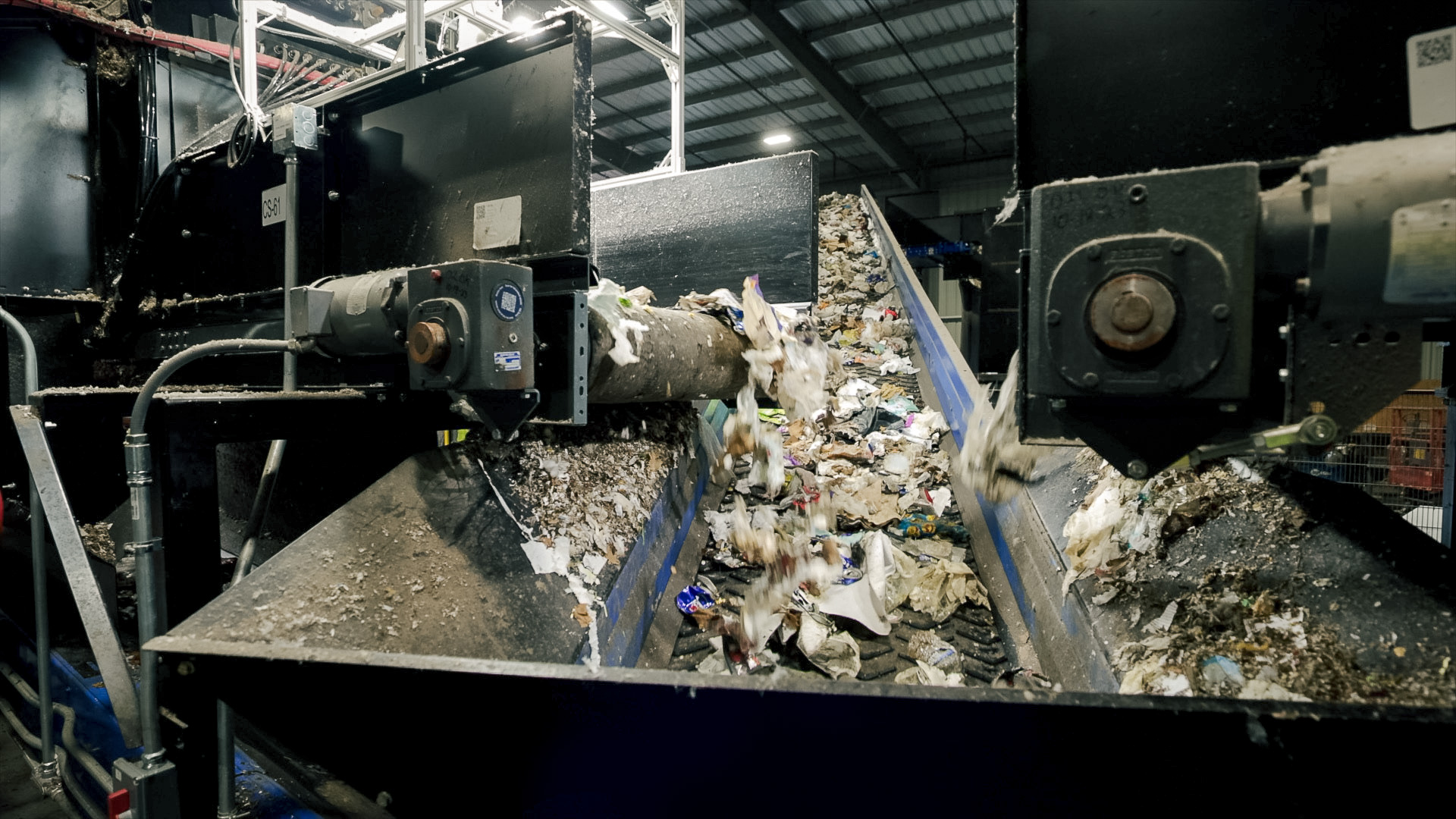
Advanced mechanical pre-treatment, enhanced by artificial intelligence, enables these high-fossil-carbon materials to be identified and removed from the residual waste stream at scale. Rather than paying to burn them, councils can divert them for recycling or alternative recovery routes, cutting emissions at the source.
AMP specialises in exactly this approach. Its AI-driven systems analyse waste in real time, separating non-biogenic carbon and valuable materials that traditional mechanical or manual processes often miss. The result is a cleaner, leaner residual stream entering EfW, with lower carbon intensity and more predictable performance.
Beyond cost avoidance, ETS also creates exposure to price volatility; by reducing the volume and carbon intensity of residual waste, sorting helps limit that exposure and supports more predictable, manageable budgets for councils.
Turning ETS from a cost into a managed variable
The financial logic of advanced sorting under ETS is compelling. By reducing both the volume and carbon intensity of residual waste sent for incineration, councils can directly lower their exposure to emission allowance requirements. Recovered materials such as plastics and metals, while subject to market volatility, can nonetheless contribute to offsetting operating costs and improving overall system economics.
CIWM modelling suggests that advanced sorting across UK EfW feedstock could deliver 2.1 to 4.1 million tonnes of CO₂ reductions annually, equivalent to £100–200 million per year in avoided ETS costs at current carbon price assumptions. Additional benefits come from reduced equipment strain, improved EfW throughput, and lower reliance on manual sampling for MRV compliance.
Throughput improvements are an additional operational benefit. Many EfW plants are constrained by thermal input, meaning their maximum throughput is constrained by the allowable thermal input to the furnace and boiler system, rather than by mechanical capacity. Reducing the calorific value or fossil-derived fraction of residual waste can therefore enable higher throughput while remaining within safe operating limits. By removing plastics and other high-calorific materials before incineration, AMP’s sorting reduces the calorific value (CV) of the residual waste, allowing plants to accept and process more material. AMP estimates that roughly 2 tonnes of additional organic material can be fed into the system for every 1 tonne of plastic removed, generating higher tip fee revenues while maintaining comparable energy output.
Unlike CCS, which remains largely outside the direct control of local authorities, sorting solutions can be deployed within existing MRFs, transfer stations, or infrastructure adjacent to EfW plants. Systems are modular, retrofittable, and typically deliver under a year from project approval, aligning far more closely with ETS timelines.
Developability is a key advantage of AMP’s approach. Unlike large-scale CCS projects, AI-driven sorting systems are capital-light, often requiring little or no upfront investment, and can be deployed within existing floor plans with no additional permitting. Councils can make the decision locally, retain direct control, and implement solutions quickly, turning what could be a multi-year, complex capital project into an achievable, near-term solution. This combination of flexibility, quick-implementation, and low upfront cost makes AMP’s approach uniquely actionable ahead of ETS enforcement.
Supporting circular economy and policy goals
Advanced sorting is not just a compliance tool; it is also strongly aligned with wider UK waste and environmental policy. Pre-treatment is explicitly recognised as a policy-approved roadmap to reducing waste-sector emissions, supporting both the Defra 25-Year Environment Plan and the Environment Act.
By recovering materials instead of burning them, councils boost recycling rates and contribute to the UK’s target of 65% recycling by 2035. Organics can be diverted to composting or anaerobic digestion, while high-quality plastics and metals are returned to the economy, strengthening domestic secondary markets.
There are also less visible but equally impactful benefits. AI-driven systems provide detailed compositional data that gives authorities better insight into their waste streams and supports more accurate reporting under ETS. Real-time monitoring allows operational inefficiencies to be identified and addressed proactively, improving resilience as waste compositions continue to evolve, particularly with the rise of synthetic textiles linked to online retail.
AI-driven compositional data strengthens governance and compliance under MRV frameworks by delivering auditable, traceable, and standardized emissions data. By automating data validation and improving the accuracy and consistency of reported emissions factors, it enhances regulatory readiness, supports third-party verification, and reduces compliance risk while increasing transparency across reporting processes.
A complementary pathway
It is important to be clear: advanced sorting is not necessarily a replacement for CCS. Instead, it is a complementary, near-term solution that reduces the carbon burden EfW facilities face, making future CCS deployment more effective and more economical.
By removing high-carbon fractions upstream, sorting lowers the volume of emissions that CCS systems would eventually need to capture, potentially reducing their size, complexity and cost. In this sense, councils that invest early in advanced sorting are not locking themselves out of CCS, they are preparing the ground for it.
Why the time to act is now
With ETS enforcement approaching, the window for proactive action is narrowing. Councils that wait risk absorbing millions of pounds in avoidable costs, with limited levers to pull once the scheme is live.
Advanced AI-driven sorting offers a rare combination of speed, affordability and impact. It delivers immediate emissions reductions, mitigates ETS exposure, generates revenue, and supports circular economy objectives, all while fitting within existing infrastructure and governance frameworks.
As regulatory pressure increases, the question for local authorities is no longer whether ETS will change the economics of waste management, but how prepared they will be when it does. For many, advanced sorting may prove to be the most practical step they can take today to control costs, cut carbon, and future-proof their systems for the decade ahead.
Even if ETS requirements change over time, sorting remains a win-win approach, improving recycling outcomes, lowering residual waste, and aligning with broader national targets.